Last Updated: October 28, 2026
Quick Summary
Pet relocation for military families starts with reading your PCS orders, then building a timeline backward from your report date. Gather vaccination and microchip records early, confirm destination entry rules, and book transport as soon as dates are set.
- Read your orders for your report date, duty station, and whether the move is CONUS or overseas.
- Gather vaccination history, microchip number, and medical notes in one folder, with digital copies.
- Overseas moves can need a rabies titer test or import permit, so add a buffer of at least 30 days.
- Save itemized receipts and get reimbursement authorization in writing from your installation transportation office before spending.
- Confirm the transportation office’s guidance on pet transport authorization before relying on reimbursement.
Table of Contents
- Planning Your Pet’s Move Around Your PCS Orders
- Preparing Your Pet Before You Receive Orders
- Health Certificates, Vaccinations and Required Documents
- Choosing Between Domestic Transport and Overseas Pet Shipping
- How Military Pet Travel Reimbursement Works
- Step-by-Step PCS Pet Moving Checklist
- Planning Ahead If Your Pet Cannot Travel
- Booking Your Pet’s Transport Before Your Move Date
- Frequently Asked Questions
Planning Your Pet’s Move Around Your PCS Orders
Pet relocation for military families takes planning, and the earlier you start, the smoother the move. A Permanent Change of Station (PCS) order can arrive with only weeks of notice, so knowing your options before orders land saves stress. At The Pet Transport Network LLC, we connect service members and their families with vetted transporters for safe, verified pet travel.
Read your orders closely: they show your duty station, report date, and whether the move is CONUS or overseas, three details that shape almost every decision that follows.
Build a timeline backward from your report date, counting weeks for vet visits, paperwork, and transport booking, then add a buffer for delays.
- Note your report date and the date you must be out of housing
- Confirm whether your move is CONUS or overseas
- Check the rules for your specific destination early
- Set calendar reminders for each step in your timeline
Watch out: waiting to start paperwork until you have a confirmed address can leave you scrambling for documents that take time to issue.
Preparing Your Pet Before You Receive Orders
You do not need orders to start getting ready. Prepare during a quiet period at your current duty station; organized records make every future move easier.
Gather your pet’s core records in one folder: vaccination history, microchip number, and past medical notes. Keep digital copies too, since airlines and foreign authorities may ask on short notice.
Schedule a routine wellness visit and ask about travel-affecting issues, such as heart or breathing conditions in short-nosed breeds, and whether your pet is fit for a long trip.
Talk with your household about travel comfort. Practice short car rides and crate time so your pet feels calm when the move begins.
Health Certificates, Vaccinations and Required Documents
Most pet moves require a health certificate issued by a licensed veterinarian shortly before travel. Rules vary by airline, state, and destination, so confirm requirements before booking.
Rabies vaccination is a common requirement. Your vet should record the vaccine date, the lot number, and the expiration date. Keep this paperwork with your pet at all times during the trip.
Overseas moves often need more: some countries require extra vaccines, blood tests, or import permits that take months. Start early, because a missed deadline can delay your pet’s arrival.
- Ask your vet for a current health certificate close to your travel date
- Keep rabies records and microchip information together
- Confirm any destination-specific forms well in advance
- Carry originals and copies of every document
Choosing Between Domestic Transport and Overseas Pet Shipping
The right option depends on your destination and lead time. Domestic and overseas moves follow different paths and paperwork deadlines, so compare them before you commit.
Domestic CONUS moves
Domestic moves within the continental U.S. usually involve ground transport or air travel in the cabin or cargo hold. Ground transport may suit pets that handle flying poorly. Air travel may have stricter size and breed rules.
A practical CONUS timeline looks like this:
- 8-12 weeks out: confirm your pet’s vaccinations and microchip are current; ask your vet whether your pet is fit to fly or is better suited to ground transport.
- 4-6 weeks out: request quotes from vetted ground and air providers; confirm crate size and airline breed or snub-nose restrictions if flying.
- Travel week: confirm pickup and drop-off times, pack food, water, medication, and a familiar blanket, and keep originals plus copies of every document with the pet.
Air travel adds airline-specific constraints worth checking before you book.
Overseas and country-specific entry rules
Overseas pet shipping adds layers of requirements, and each destination has its own rules, some have strict quarantine periods, others require only a health certificate and rabies proof. Check the destination’s official animal-import authority before planning anything else, and again close to travel, because rules change.
A destination-specific checklist should cover, at minimum:
- Microchip: confirm the standard (ISO 15-digit is common internationally) and that the chip was implanted before the rabies vaccination, since some countries require that order.
- Rabies vaccination: confirm the minimum age at vaccination and the waiting period the destination requires after the shot.
- Additional vaccines and tests: some destinations require specific vaccines or a rabies titer (blood antibody) test with a waiting period that can run several months.
- Import permit: some countries require a permit issued in advance; apply as early as the destination allows.
- Quarantine: confirm whether quarantine applies, for how long, and whether it can be served at home or only at an approved facility.
- Health certificate: confirm which form the destination accepts and how close to arrival it must be issued.
- Airline and route: confirm which carriers fly the route, whether they accept your pet in cabin or cargo, and whether any connection creates a problem.
Overseas transport requires checking destination-specific requirements and planning accordingly.
For overseas moves, work backward from your report date and add a buffer of at least 30 days beyond the longest requirement you find (usually the rabies titer or permit). If any requirement cannot be completed in time, that is the moment to consider a later transport or an alternative arrangement rather than to hope the deadline slips.
Urgent PCS moves
When orders arrive with only a few weeks of notice, triage rather than panic. Rabies vaccination timing, titer tests, and import permits cannot be compressed; booking and ground transport often can. If requirements cannot be met in time, plan a later transport and interim care rather than ship a pet without the required documents.
Decision criteria
Use these questions to choose between domestic and overseas paths, and between ground and air:
- Can my pet physically handle the trip? Short-nosed breeds, senior animals, and pets with heart or breathing conditions may do better on ground transport or may need a vet’s clearance to fly.
- What is the longest non-compressible requirement? That number, not your report date, sets your real deadline.
- How many pets, and how large? Multiple or large pets change crate, airline, and cost calculations and may exceed what a single shipment can handle.
- What is my out-of-pocket gap? Overseas shipping is typically the most expensive path; confirm what your orders authorize before you commit.
- What is my fallback? Identify a temporary foster or family-care option before you need it, so a missed deadline does not become a crisis.
Watch out: entry rules can change, and a plan that was correct six months ago may not be correct today. Verify requirements directly with the destination’s official authority close to your travel date, and keep dated copies of the guidance you relied on.
How Military Pet Travel Reimbursement Works
Pet travel reimbursement may depend on your PCS travel authorization. Verify applicable rules before relying on reimbursement.
Who sets the rules
Check current official guidance and ask your installation transportation office which expenses your orders authorize.
What is typically eligible, and what usually is not
Confirm the current covered-expense list with your installation transportation office before you pay for anything you intend to claim.
The claim walkthrough
- Confirm authorization before you spend. Ask your installation transportation office whether pet transport is authorized on your orders and what documentation they require. Get the answer in writing (email is fine).
- Keep the paper trail from day one. Save itemized receipts, the health certificate, vaccination records, the transport contract, and proof of payment.
- Use the right booking channel. Confirm how your booking channel affects any reimbursement before arranging transport.
Verify current allowance amounts and eligibility with your installation transportation office before you commit to a transporter.
How to verify the current policy in 15 minutes
- Call or email your installation transportation office and ask whether pet transport is authorized on your orders and what current guidance applies.
- Keep a dated copy of the guidance you are given.
Joint Travel Regulations and travel guidance
Planning for the out-of-pocket gap
Build a simple budget with three columns, transport, veterinary/documentation, and contingency, and ask your installation transportation office which line items may be eligible for reimbursement.
Step-by-Step PCS Pet Moving Checklist
Use this checklist to keep your pet’s move on track from start to finish.
- Review your orders. Note your report date, duty station, and move type.
- Update your pet’s records. Gather microchip, vaccine, and medical files.
- Book a vet visit. Schedule a health exam and request a health certificate.
- Confirm destination rules. Check entry, quarantine, and permit requirements.
- Choose your transport method. Compare ground and air options for your move.
- Book transport early. Secure your spot before peak moving season.
- Pack a travel kit. Include food, water, medication, a leash, and a familiar blanket.
- Track your reimbursement. Save receipts and submit your claim after arrival.
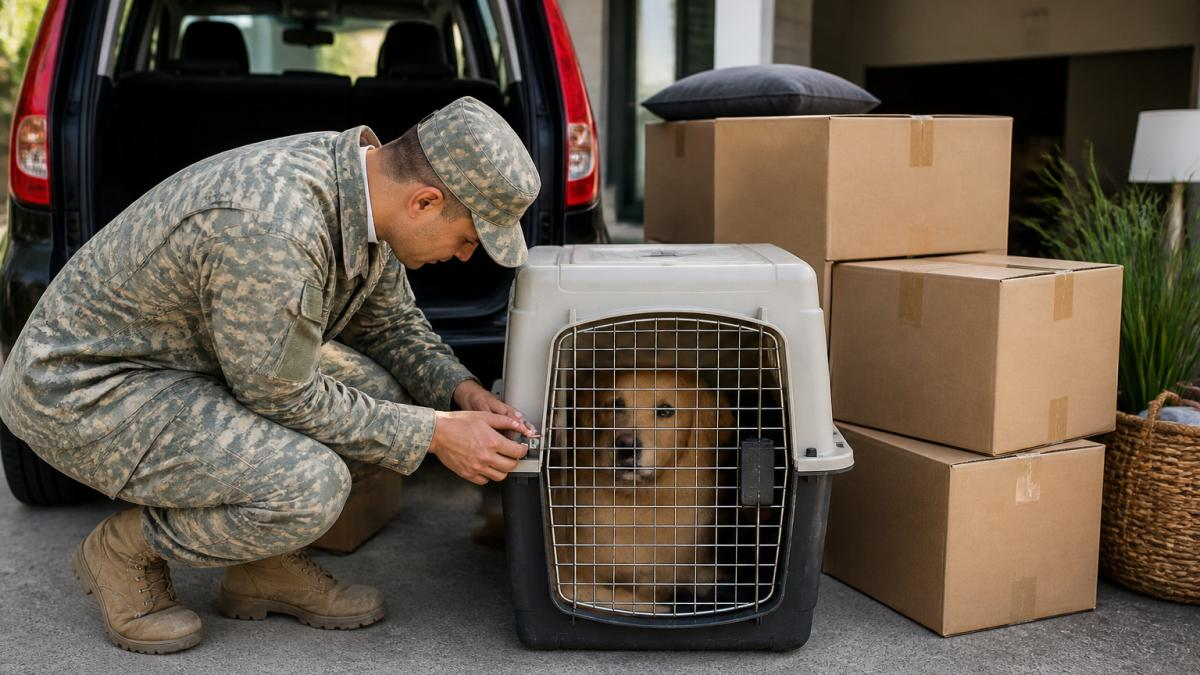
![A military family’s dog being settled into a travel crate beside packed moving boxes in a driveway, a service member’s hands fastening the crate door | section:Step-by-Step PCS Pet Moving Checklist]
The checklist below condenses the steps into a quick reference with the timing for each.
| Step | What to do | Timing |
|---|---|---|
| Review your orders | Note report date, duty station, and move type | Immediately on receipt |
| Update pet records | Gather microchip, vaccine, and medical files | Before booking vet visit |
| Book vet visit | Schedule health exam and request health certificate | Close to travel date |
| Confirm destination rules | Check entry, quarantine, and permit requirements | Before choosing transport |
| Choose transport method | Compare ground and air options | Before booking |
| Book transport early | Secure spot before peak moving season | As soon as dates are confirmed |
| Pack travel kit | Food, water, medication, leash, familiar blanket | Before travel week |
| Track reimbursement | Save receipts and submit claim after arrival | After arrival |
Planning Ahead If Your Pet Cannot Travel
Some pets cannot safely make a long trip. Older animals, pets with serious health conditions, and those with severe anxiety may need a different plan, so talk with your vet early.
Options include a temporary foster home near your old duty station, a trusted friend or relative who can care for your pet until you are settled, or a planned later transport once your pet is stable. Weigh the costs, emotional impact, and your family’s schedule.
Some pets need a short-term arrangement while you find housing that allows animals. Start that search early, because rental rules can limit your choices.
Booking Your Pet’s Transport Before Your Move Date
Book transport as soon as you have confirmed dates. Popular travel periods fill up quickly, and last-minute options may cost more or offer fewer choices. Early booking also leaves time to fix paperwork problems.
Ask each provider how they handle vetted drivers, insurance, and trip updates; clear answers help you choose a service you trust. Confirm pickup and drop-off times, and have your pet’s crate and documents ready before the driver arrives.
On The Pet Transport Network, you can connect with verified transporters. Pricing depends on quantity, dates, and delivery, so visit our website for current prices or a quote.
Frequently Asked Questions
How do military families move pets during a PCS?
Pet owners can handle transport themselves or book a pet transport provider. Confirm current requirements with your airline or transport provider before booking.
Does the military reimburse pet relocation costs?
Check current official guidance and ask your installation transportation office which rules apply to your orders before you commit to a booking.
What documents does a pet need for an overseas military move?
Documentation depends on the destination. Check the destination’s official entry requirements early and keep relevant paperwork together for the trip.
How far in advance should I plan a PCS move with a pet?
Plan ahead for your move and check destination requirements early. Use the time to gather vaccination records and consider transport options.
